One source of truth
Testing, filings and billing read the same census and ledger, so a fix made once is reflected everywhere.
Stop reconciling your own systems against each other. KinetiPlan keeps plan administration and the participant ledger in one data model, so every payroll file is validated once and every later step uses the same records.
Integrated TPA administration and recordkeeping means the plan's administrative data (provisions, census, eligibility, testing, deadlines, filings) and its recordkeeping data (contributions, participant balances, transactions, settlements) live in one system and one data model. A payroll file is validated once, posted once, and the same records drive testing, Form 5500 and billing.
The alternative, which most independent TPAs run today, is a separate recordkeeping platform plus separate administration and testing tools, connected by exports, spreadsheets and re-keying. That model works, but every boundary needs a reconciliation step and a person to do it.
| Work step | Separate systems | Integrated (KinetiPlan approach) |
|---|---|---|
| Payroll file arrives | Loaded to the recordkeeper; a copy is checked in a spreadsheet | Validated against the plan census at upload, then posted to the ledger |
| Census for testing | Exported from the recordkeeper and payroll, merged and cleaned by hand | Already on the plan record, with year-to-date contributions from posted payroll |
| ADP/ACP and limit testing | Run in a separate testing tool from the merged file | Run on the plan's own census and ledger data |
| Corrections | Calculated in the testing tool, keyed back into the recordkeeper | Corrective items listed with deadlines on the same plan record |
| Form 5500 | Data re-keyed or imported into a forms product | Generated from the plan record and filed directly with EFAST2 after human approval |
| Audit trail | Spread across emails, files and systems | Exceptions, approvals and ledger postings kept with timestamps and notes |
Testing, filings and billing read the same census and ledger, so a fix made once is reflected everywhere.
Payroll problems are caught at upload, not in February when the testing census is assembled.
No routine export, merge and re-key cycle between recordkeeping and administration tools.
Every exception has an owner, a reason and a resolution note in one queue.
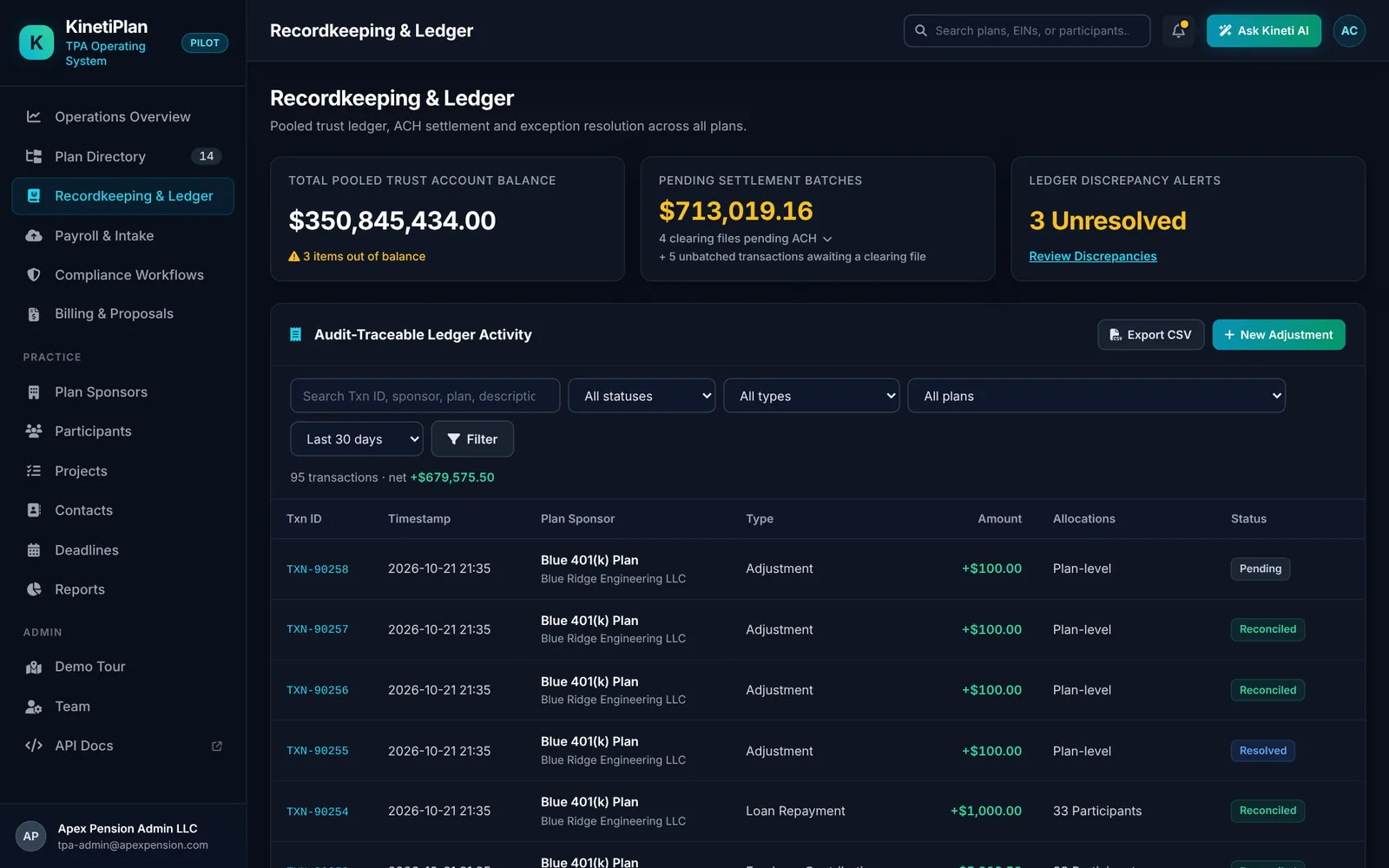
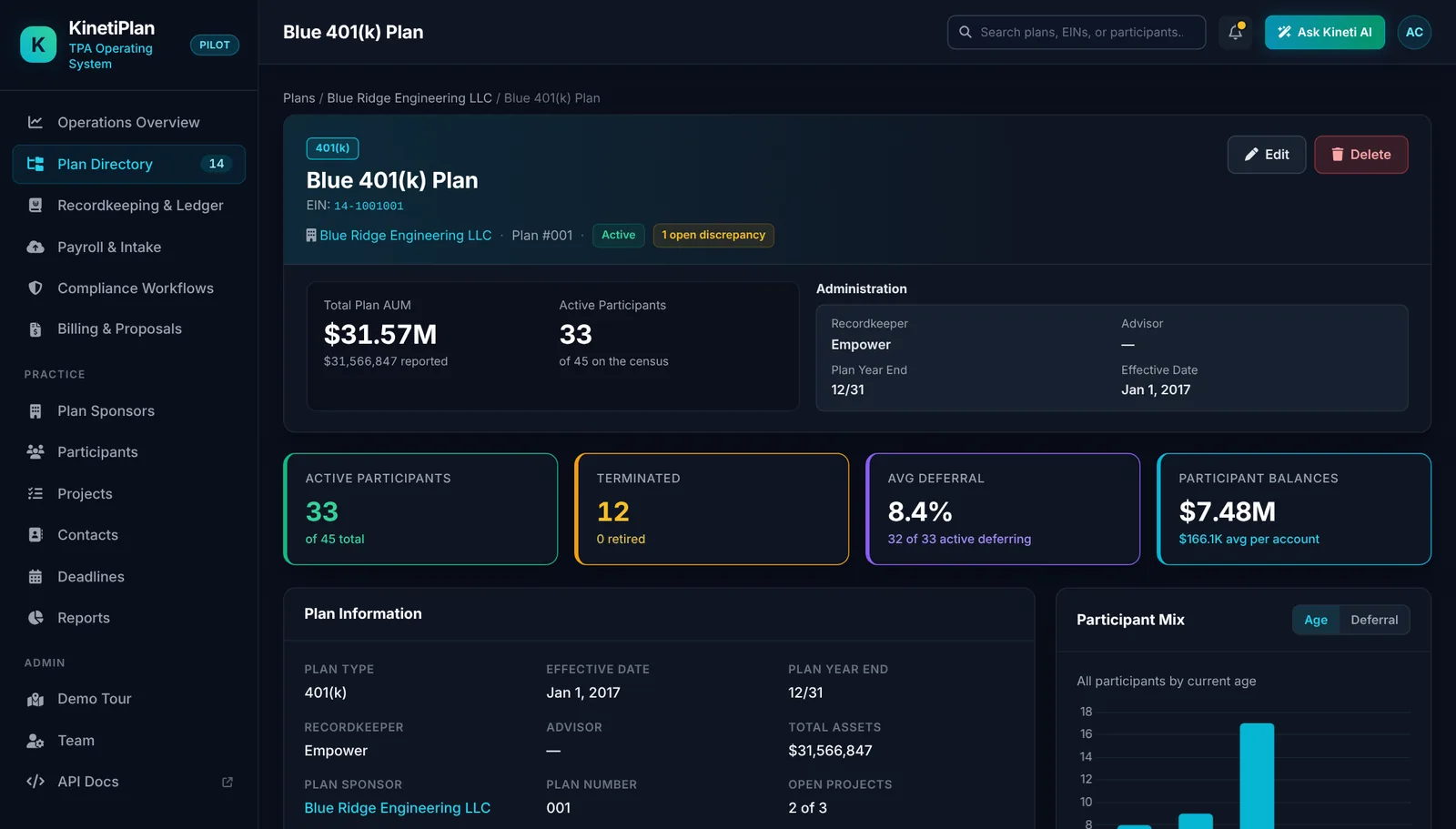
The plan record pulls together plan details, participants, ledger activity, payroll batches, projects and open discrepancies. The ledger shows the pooled trust balance, pending ACH settlement batches and discrepancy alerts that open a resolution queue.
Many TPAs administer plans whose assets and participant accounts are kept by a bundled or daily-valued recordkeeper. In that case the recordkeeper remains the system of record for balances, and the TPA's job is to reconcile against it. KinetiPlan supports that model by importing external records and flagging differences for review. It does not connect live to custodians or recordkeepers today.
A sensible approach is to start integration with the plans where your firm already keeps the books, such as balance-forward or pooled plans, and keep reconciliation workflows for the rest. The vendor-neutral comparison article covers the decision in more depth.
KinetiPlan is software. A TPA using it can keep participant-level records and a pooled trust ledger in it. KinetiPlan records ACH settlement batches but does not move money or hold assets.
Yes. For plans where an outside recordkeeper is the system of record, external records can be imported and compared, with differences flagged for staff review.
No. A pilot usually starts with a contained set of plans. See the migration protocol.
A 15-minute walkthrough of the pilot build with synthetic data, focused on the process you pick. No slides required.